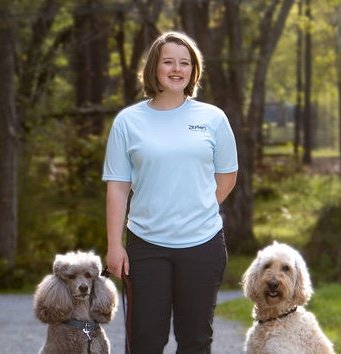
Three things send new puppy owners scrambling for help more than anything else: the biting, the jumping, and the puddles. If your sweet new puppy has turned your hands into chew toys, your guests into launch pads, and your floors into a minefield, you are in extremely normal company.
Here's the reassuring truth underneath all three: none of these are signs of a "bad" puppy, and none of them mean you're doing it wrong. They're just normal puppy behaviors that haven't been redirected yet. Let's walk through each one, with the approach I actually use and teach.
⸻
How do I stop my puppy from biting?
The fastest way to stop puppy biting is to redirect those teeth onto an appropriate chew toy every single time, and to make sure your puppy has enough outlets for chewing, teething, and play. Punishing the biting tends to backfire — it either winds the puppy up more or teaches them to be nervous around your hands.
Puppies explore the world with their mouths, and on top of that, they're teething for months. Biting isn't aggression; it's information-gathering and pain relief. So our job isn't to stamp it out, it's to teach your puppy what is okay to bite.
A few things that genuinely work: keep a soft toy within reach and offer it the instant the teeth come out, so the answer to "what do I bite?" is always available. When your puppy bites skin, calmly end the fun — stand up, step away, or briefly pause the game — so they learn that teeth-on-skin makes the good times stop. Reward gentle mouth and calm moments generously. And make sure the basics are covered, because an overtired, under-exercised, or over-stimulated puppy bites far more. Sometimes the "biting problem" is really a "this puppy needs a nap" problem.
⸻
How do I stop my puppy from jumping on people?
To stop a puppy from jumping, reward four-on-the-floor and calm greetings, and stop giving attention for the jump itself. Puppies jump because it works — it gets them the thing they want most, which is your face and your attention.
The trick is to flip what gets rewarded. When your puppy jumps, the attention disappears: turn away, step back, and wait. The moment all four paws are on the ground, the good stuff returns — praise, pets, treats. You are showing them that keeping their feet down is what opens the door to connection.
⸻
How do I potty train my puppy?
Successful potty training comes down to three things: frequent trips outside, generous rewards for going in the right spot, and close supervision (or a crate) to prevent accidents indoors. The more you can prevent accidents from happening, the faster the whole thing clicks.
Take your puppy out often — after waking, after eating, after play, and roughly every hour or two for a young puppy. Go to the same spot, wait, and the moment they finish, throw a little party: treat, praise, the works. That immediate reward is what teaches them that outside is where the magic happens.
Between trips, supervise closely or use a crate or playpen, because a puppy who can't sneak off to the dining room can't practice the wrong habit. And when accidents happen (they will), simply clean it up thoroughly with an enzymatic cleaner and move on. There's no value in scolding after the fact, your puppy won't connect it to the puddle, and it can teach them to hide when they need to go. Accidents are just data: they usually mean we need more frequent trips or closer supervision for a bit.
⸻
Does punishment seem to work?
This is worth pausing on, because old-school advice still floats around for all three of these. You might hear suggestions to bop a nose, hold a puppy's mouth shut, knee them for jumping, or rub their face in an accident.
Please skip all of it. Even when punishment appears to stop a behavior in the moment, it works by creating fear or confusion, and it comes at a real cost: a puppy who's more anxious, less trusting, and more likely to use bigger warning signals down the road. Everything above gets you the same results, often faster, while building a dog who feels safe with you. That's the whole point.
⸻
FAQs
Why does my puppy bite so much?
Puppies explore with their mouths and teethe for months, so biting is completely normal. It spikes when they're overtired, overstimulated, or under-exercised. Redirect to a toy and make sure their needs for rest and play are met.
At what age do puppies stop biting?
Most puppies bite hardest between about 8 and 16 weeks and ease off as their adult teeth come in around 6 to 7 months, especially with consistent redirection. It's a phase, not a personality.
How long does it take to potty train a puppy?
Many puppies are largely reliable by 4 to 6 months with consistent routines, though young puppies physically can't "hold it" for long. Frequent trips, rewards, and supervision speed things up.
Should I punish my puppy for accidents or biting?
No. Punishment after the fact doesn't teach the right behavior and can create fear and hiding. Prevent, redirect, and reward instead, it's faster and protects your relationship.
Why does my puppy jump on guests and how do I stop it?
Jumping gets attention, so it keeps happening. Ignore the jump, reward four-on-the-floor, or put puppy in a pen until the excitement wears off. Ask every visitor to follow the same rule.
⸻
Biting, jumping, and potty accidents all come down to the same thing: a young puppy doing exactly what puppies do, waiting to be shown a better option. Your job isn't to suppress them. It's to teach, redirect, and reward.
That work is so much easier with another set of eyes and a plan. My Puppy Preschool here in Tallahassee tackles these exact challenges in a supportive group setting, and if you'd like hands-on help tailored to your puppy and your home, my private lessons start with a free consultation. You don't have to white-knuckle this phase alone.
It really does get better, usually faster than you'd believe.
TLDR
Puppy biting, jumping, and potty accidents are normal developmental behaviors, not signs of a bad puppy. Stop biting by redirecting to toys and meeting your puppy's needs for rest and play. Stop jumping by ignoring the jump and rewarding four-on-the-floor and sits. Potty train with frequent outdoor trips, immediate rewards for going outside, and close supervision to prevent indoor accidents. Skip all punishment — it creates fear and damages trust without working better. Prevent, redirect, and reward, and these phases pass.