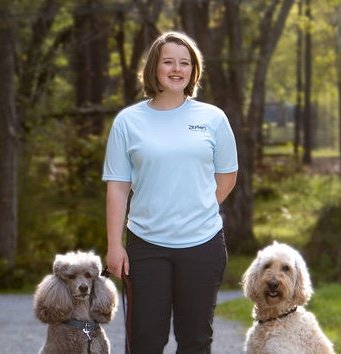
At sixteen, in true teenage fashion, I thought I knew everything and was absolutely certain that I was a dog expert.
And to be fair… I did know a lot.
I’d been in a veterinary assisting program since I was fourteen, spending my afternoons shadowing vets, handing off surgical instruments, working under canine trainers, and generally collecting animal knowledge like it was a competitive sport. I had credentials. I had experience. I had ✨confidence✨ and most importantly, I had absolutely no idea how much I was missing.
At sixteen, I was training with a police K9 trainer I met through school. He was the kind of person who could take a chaotic, high-strung malinois and turn them into a focused, disciplined working machine. It was impressive, it was effective, and it worked, so I didn’t question it.
Why would I? I was sixteen. I worked with animals professionally. I knew things.
At the exact same time, I was working in a veterinary clinic, where every single day I was seeing dogs who were not okay. Dogs frozen on the exam table. Other dogs planting their feet at the doorway like they were going to be forced through a haunted house. Dogs panting, trembling, refusing treats while everyone in the room said, “Oh, you are just fine.”
Including me.
You see, I had been trained to look at the clinical picture such as vitals, symptoms, and procedures. I was not trained to see quieter messages: a yawn that has nothing to do with being tired, panting that says I am one second away from a panic attack, and stillness resulted from a dog completely shutting down.
I was watching stress unfold in real time, fully convinced I understood what I was seeing.
⸻
Enter: Zephyr
My first dog, arriving right in the peak teenage know-it-all era.I did her vaccines, assisted in her spay, and trained her to be, by all visible standards, a perfect dog. She could do everything I asked. She listened, she performed, she checked every box I thought mattered.
And while she was learning how to be a great dog from a human perspective, I was still learning how to be a good trainer from a dog’s perspective. We just didn’t know that yet.
⸻
The moment everything got uncomfortable
I took a Fear Free certification course through the clinic, and this is where things started to unravel in the best way. Because suddenly, all those little things I had been seeing but not seeing had names:
Fear. Stress. Anxiety.
And once you see it, you can’t unsee it.
Which led to the question: If fear is quietly wrecking dogs in the exam room, what is it doing in training? More specifically, what is it doing in training methods that rely on the dog’s discomfort?
I started questioning things and then I slowly began to quietly re-evaluate everything I thought I knew (which is deeply inconvenient when you already think you know everything.)
⸻
my unlearning era
In college, I had the chance to work under a mentor who used positive reinforcement exclusively. That’s where things began to shift. I started seeing dogs who weren’t just compliant, but engaged- dogs who chose to participate and actually understood what was being asked of them.
And the science? It just kept backing it up. Over and over again, the same conclusion: Dogs learn better, retain more, and hold up under pressure more reliably when training is built on reward rather than correction. Not a trend. Not a style. This is just how learning works.
⸻
Zephyr, ten years later
Zephyr is ten now, and she has lived through every phase of my learning curve. She learned how to live in a human world while I learned how to better meet her in her world, and somewhere along the way, that became the foundation of everything I do now.
She’s the reason this business exists. She’s the reason it carries her name. And she is, without question, the most important dog I have ever worked with. This is not because I did everything right, but because she was there while I figured out how to do better.
⸻
what this means for you (and your dog)
If you’re feeling frustrated, if your dog isn’t responding the way you expected, or if things just don’t feel quite right, congrats, you have reached the uncomfortable point of growth that all great pet owners inevitably reach. You’re not failing. It just means that it’s time to pivot and think outside of the box.
If you’re in that in-between space, where things aren’t quite clicking but you know there has to be a better way, you don’t have to figure it out alone. That’s where we come in and where we start building something that works and actually lasts.
I used to think being a good trainer meant knowing everything. Now I know it means being willing to learn, even when it’s a little uncomfortable.
TLDR
I went from confident, correction-based training to a science-backed, reward-based approach after realizing how much I was missing about canine behavior. Now I help dog owners train with clarity, compassion, and methods that are proven to last.